-
In the summer of 2009, AVillage, Inc., a grassroots organization committed to improving the quality of life in Albany’s South End neighborhood, engaged my services. The advocacy group sought direct CDTA bus service from this low income, inner city neighborhood to the corridor housing three of the City’s major medical centers (i.e. Albany Stratton VA Medical Center, Albany Medical Center and St. Peter’s Hospital). Joining this effort were its community partners – Trinity Alliance of the Capital Region,Grand Street Community Arts Center, and Westminster Presbyterian Church.
As an economically disadvantaged neighborhood, a high percentage of South End residents do not have cars, making them dependent on transit to meet their transportation needs. While transit service was available in the neighborhood, it was impractical to reach the hospitals. It required residents to take a bus or walk downtown, significantly lengthening their commute, or walk up steep Morton Avenue to catch cross-town service, a difficult climb, particularly for the community’s disabled and large senior population. Too often, residents would miss appointments or pay expensive cab fares to make these trips. The requested service would give South End residents direct access to job opportunities, medical appointments, shopping and other businesses as well as transfers to buses serving the greater Capital District.
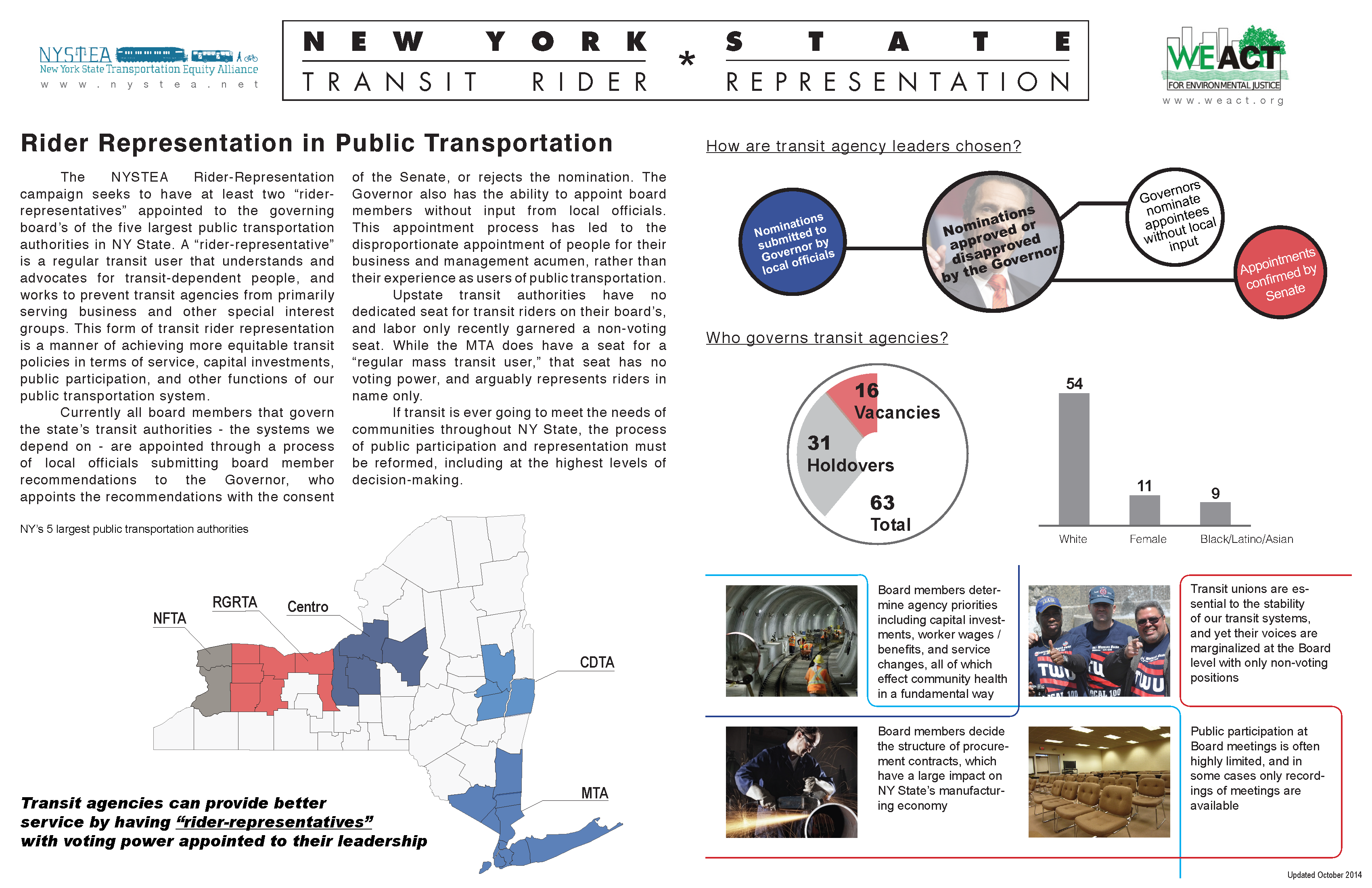
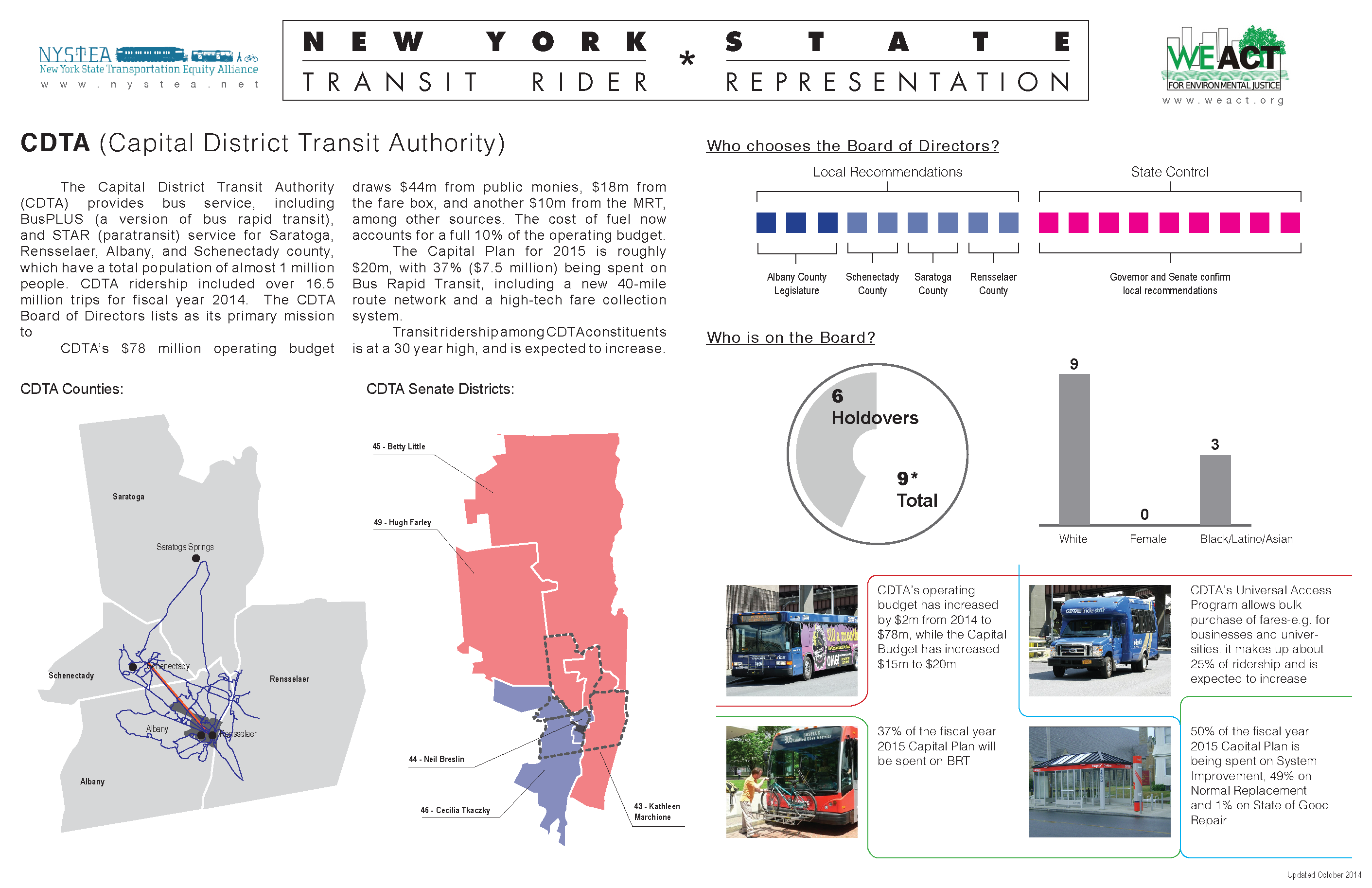
Our first step in addressing the transit issue was to speak with transportation staff. They were unconvinced of the level of demand for service and doubtful that even if the demand were there, we would see any new service given CDTA’s shrinking funding. In response we decided to approach the CDTA Board. Looking at the composition of its members, we noted that: 1) none of the nine members came from one of the four cities within the Capital District, 2) none were actual transit riders though one was a transit advocate; and 3) there was an Albany County seat vacancy.
Soon thereafter we approached the CDTA Board with a petition signed by over 1,300 people, the majority of whom were from the South End or the other inner city neighborhoods which would benefit the most from this service. We also presented the results of a transportation questionnaire showing a large pent up demand for the service especially for medical and work trips, and its anticipated frequent use (2-5X/week). Finally, we gave them support letters from fourteen prominent individuals and organizations, among them Albany Medical Center, City of Albany Common Council members, the Albany Housing Authority, local housing and human service groups, church leaders, and neighborhood associations.

Ultimately the service was created through a new transit loop serving not only the South End but Arbor Hill and West Hill as well, giving all three inner city neighborhoods a direct connection to the medical centers. (CDTA has since reported that ridership on this new route is double what was expected to the point that overcrowding is now an issue.)
On November 13, 2011 I joined about a hundred South End residents and community leaders gathered at the Union Missionary Baptist Church on Morton Avenue. We chanted “this is how democracy works” as the new CDTA bus #100 pulled up for the first time. A major victory had been won for both the neighborhood and for CDTA.
By Monique Wahba, Principal and Owner of MW Planning (www.mwplanning.org)
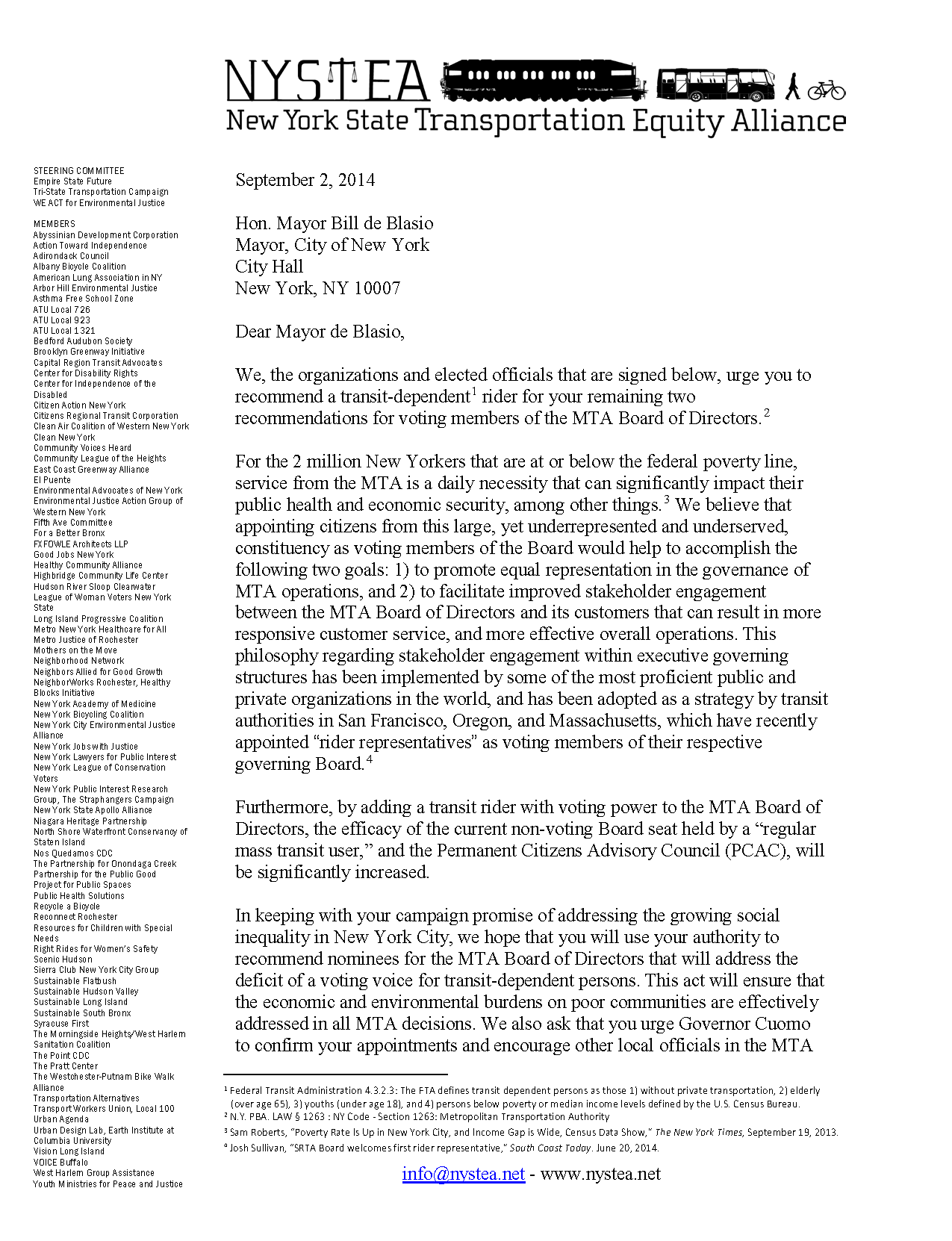
CDTA and local organizations have proven that system operators throughout New York State can make positive steps forward by engaging communities to best utilize existing resources. But we here at the New York State Transportation Equity Alliance (NYSTEA) and our 80+ coalition members see that there are fundamental statewide issues that need to be addressed. Join NYSTEA as we make the case for voting rider representation on transit authority boards. Riders can and should have the right to be recognized as a transit stakeholder.
-
Albany has passed the 2012-2013 State Budget on time for the second consecutive year. Compared to previous years, transit made out pretty well:
MTA Capital Plan
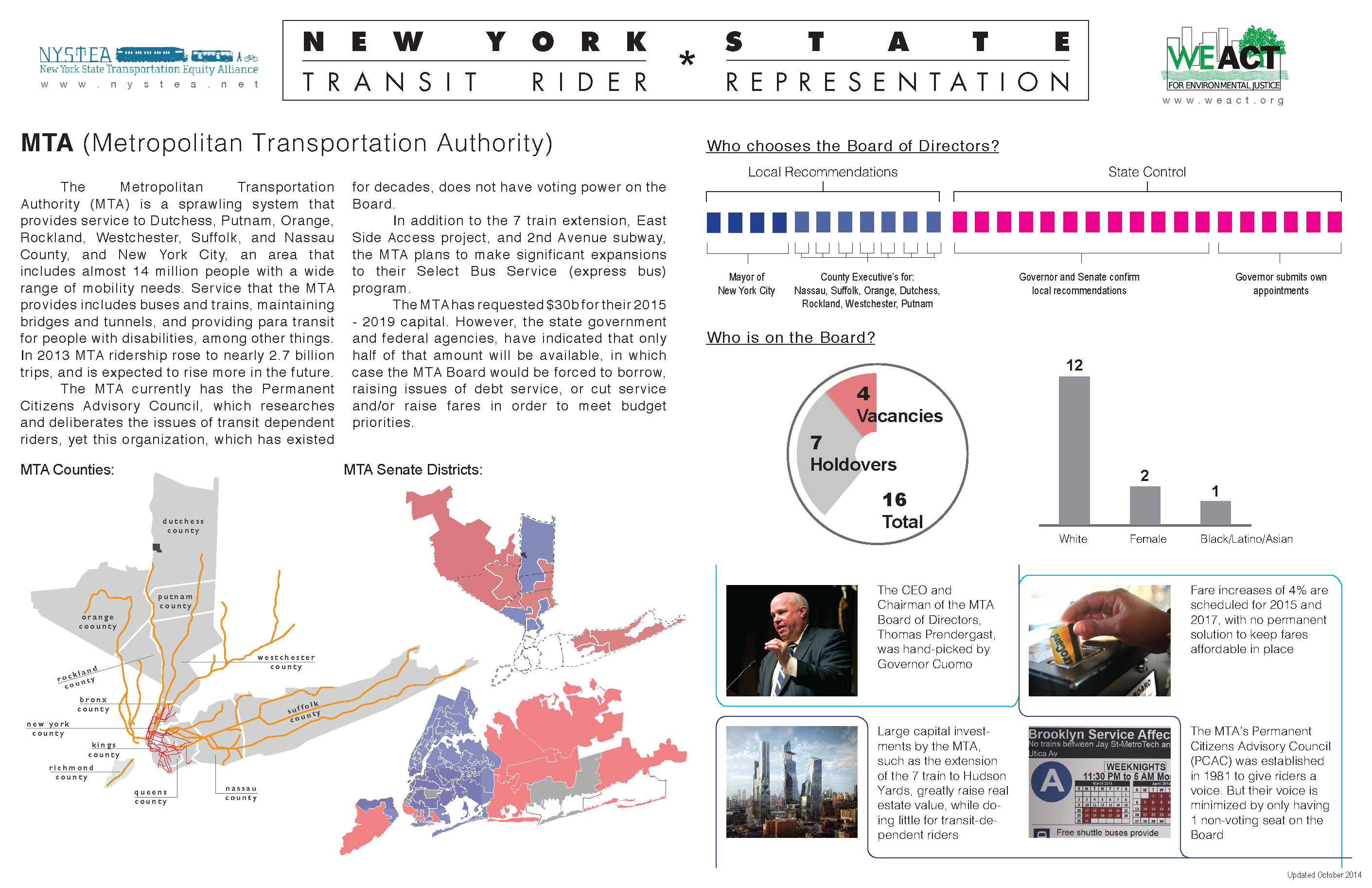
In the end, the State decided to support the MTA’s Capital Program, despite the Senate’s proposal to scratch $770 million in capital funding and refuse to raise the agency’s debt limit. The State’s support will go a long way to help prop up the underfunded program that maintains and expands the MTA network. The capital program creates 350,000 jobs and $44 billion in economic benefit for New York State, in part due to the state’s extensive transit manufacturing sector.
Unfortunately, the heavy reliance on outside lending has troubling repercussions down the road. Already, 17% of the operating budget goes to debt service on current and past projects. The NYS Comptroller estimates annual debt service will grow to $3.3 billion (over 22% of the operating budget) in 2018, with the increased debt burden putting further strain on fares and service levels. Riders are preparing for the MTA’s upcoming fare hike at the beginning of next year. Like the last fare increase, this is likely to have a particularly burdensome effect on low-income communities and communities of color in the outer boroughs. Fare increases are also planned for 2015 and 2017.

Upstate transit gets some help
Upstate systems will be helped by a 6.95% increase in operating funding. A corporate and utilities tax, which is collected statewide but has previously gone only to downstate systems, will now go to fund transit across the state for the next year. The Governor’s budget proposed this as a permanent reform, but backlash from the Assembly constrained it to only one year. The state is also releasing $16 million of capital moneypreviously allocated for upstate transit providers. It’s unclear whether the funding increase will be enough to stop a double-digit-percentage fare hike and 6% service reduction for NFTA riders, or hold back layoffs and route reductions for the CDTA, but this is certainly a welcome improvement over previous years.
BRT on the Tappan Zee Bridge
Unfortunately, the budget did not include language to secure Bus Rapid Transit as part of the rebuilding of the Tappan Zee Bridge (in fact, funding has not been identified for the bridge itself). Senators Martin Dilan and John Bonacic issued a bipartisan call for Tappan Zee BRT, which would provide affordable and environmentally friendly transit trips across the Hudson River.
-
New York State’s 2012 draft budget gave transportation some much-needed attention. If the plan is adopted, the state will dispense $4.4 billion to New York’s transit systems ($4 billion to the MTA and $430 million to non-MTA systems). The increase in aid comes from tax restructuring and revenue increases from various dedicated taxes (MMTOA) that pay for transit.
Here are some of the budget’s notable transportation components:
Upstate transit systems get attention: upstate bus systems have long struggled to deliver service. Bus systems currently receive revenue from the petroleum business tax, which has brought in less money over the years. To address this, the Governor proposed a redistribution of the Transmission Tax (also known as the “Long Lines Tax”) more equitably between downstate and upstate systems. Instead of a yearly transfer of tax revenue between upstate and downstate, funds would be distributed based on population. This would bring in an additional $11 million in aid to upstate transit systems. NYSTEA and TSTC have pointed out that existing funding structures have proven inadequate for upstate transit systems; this reform is a good start towards the broader fixes which will be needed.
The MTA gets paid back: thanks to pressure from transit advocacy groups, Governor Cuomo’s proposed budget keeps his promise to fill the $310 million gap in the MTA’s budget caused by the reformed payroll mobility tax deal in December. The restructuring worried transit advocates, who feared that the drop in yearly revenue would trigger another fare increase and service cut in 2012. State sources indicate that the MTA will be compensated for the full $310 million over the state’s fiscal year (which runs April 1 through March 31). The state would also reimburse the MTA for costs associated with an EZ Pass rebate program for Queens residents that use the Cross Bay Veterans Memorial Bridge.
The MTA Capital Program gets additional state commitment: the state would give an additional $770 million over the remaining three years of the MTA’s construction effort. This aid would be accompanied by a $7 billion increase in the MTA’s debt ceiling (from $34 billion to $41 billion), which would finance the bulk of the capital program. State legislation is required for this action.
Tappan Zee bridge construction bill has not been resolved: the Governor reiterated his proposal to fund the Tappan Zee Bridge replacement project with $5 billion from a New York Works Infrastructure Fund, with the New York State Thruway Authority being the responsible entity. It is still unclear how the Thruway Authority would pay for the replacement, though increased tolls and taxes seem to be the most likely options. Meanwhile, BRTontheBridge.org was launched earlier this month to advocate for a bridge replacement plan that includes the public transportation communities need.
The draft budget is already having an effect. In Buffalo, where the Niagara-Frontier Transportation Authority (NFTA) is about to start hearings on a proposed 22% cut in service miles, transit riders are making their voices heard. According to NFTA Executive Director, Kimberley A. Minkel, the extensive public comment and the additional money from Albany has the Authority considering a change of direction—they’re now considering a $.25 increase in fares and a 5% cut in service instead.
Veronica Vanterpool is associate director of the Tri-State Transportation Campaign, a member of the NYSTEA steering committee.
-
Yesterday, the commissioners of the Niagara Frontier Transportation Authority (NFTA) formally adopted a plan to cut 22% of service miles from their Metro transit system.
These cuts attempt to address NFTA’s $7.1 million budget shortfall, which stems from increased operating costs and reduced funding from Albany (money that’s known as State Operating Assistance, or STOA). Since 2009, Buffalo has seen a $3.6 million reduction in STOA and a $7 million increase in operating costs, and they’re not the only transit system in the state that’s suffered from these cutbacks.
NFTA, like many transit systems, isn’t scaling back service because people aren’t taking the bus. With 27 million annual passengers and over 1,600 employees, it’s the second largest transit provider in the state. Approximately 84% of metro riders use the system to get to work, and 77% of these don’t own a car. As a coalition of advocates noted last week, this means that these cuts “will undermine all other efforts to spur economic development in our region—even if we create jobs, people won’t be able to get to them.”

In a city with the 3rd highest poverty rate in the country, these cuts will deeply constrain access to economic recoveryfor many low-income Buffalonians. Additionally, as America’s 6th most segregated city, these cuts will also likely create a heavy burden on people of color who use the system. As many vulnerable communities are concentrated near transit hubs, reductions in service will impair their ability to access their jobs. Riders who “reverse commute” from inner urban areas out to jobs in the suburbs will also be negatively affected as many of these routes will be cut.
Faced with this hard reality—an economically vital transit system that can’t make ends meet—NFTA has requested $10 million from Albany during the 2012-13 fiscal year. They also requested eight megawatts of low-cost power from the New York Power Authority, which would provide $1.8 million in annual operating savings. Buffalo officials have been joined by Erie County and New York State legislators in their calls for help from Governor Cuomo. NYSTEA and several other advocacy organizations have joined this fight.
The situation is dire. Unless NFTA gets more funding, it will have few choices beyond cutting routes and raising fares. Across New York, transportation authorities are implementing cost saving measures, but they can only fasten their belts so much before they cut off circulation entirely.
To help NFTA and other New York transit agencies stay alive, demand that Albany stand up for transit.
-
By Vision Long Island
Long Island Bus has dominated transportation discussions for the last several months, not only on Long Island but in the entire tri-state region. Essentially, one of the nation’s largest suburban bus systems is about to make the switch from a publically-run system to a privately-run one. The process has been a debacle, with new developments unfolding every week for the last several months.
Several months ago, the Metropolitan Transportation Authority proposed severe service cuts as a reaction to an ongoing funding dispute. At the same time, the public felt that the imposition of the MTA payroll tax should at least hold the line on bus service provision through these difficult times. County residents, business owners and lawmakers were furious. Unfortunately, MTA and Nassau County leadership chose a hardball approach to bargaining that left bus riders in the cold.
Now the central player is Nassau County – who owns the buses. The process of ending ties with the MTA and awarding the private bid to Veolia Transportation – a French-owned company with American offices – has been defined by a lack of transparency. The County has yet to hold a public hearing, and the system’s 100,000 daily riders are terrified that their routes will be cut and fares increased. Veolia quietly signed a contract in October, but the details of that contract were not released to the public or the County Legislature—who must review and approve the contract before it is enacted—until two days after Election Day. The latest news is that the contract has passed through the Rules Committee into the full Legislature, who will finally hold a public hearing on December 5th and vote on the contract shortly thereafter.
Meanwhile, the MTA has issued 981 layoff notices, and the County passed a 2012 budget with only a $2.5 million contribution for LI Bus – representing a 73% decrease from 2011. Our neighboring suburban counties, which have slightly smaller bus systems than Nassau County, pay between $25 million and $35 million a year to run their public-private partnerships. If Veolia does not take a substantial loss, there will most certainly be service cuts, fare increases and/or layoffs.
There seems to be little hope, but Nassau bus riders and supporters are fighting back and making an impact. Community and business groups have come together to wage a campaign to save Long Island Bus. Vision Long Island is a partner in a long list, which includes Tri-State Transportation Campaign, LI Jobs With Justice, NYPIRG, NY Communities for Change, LI Federation of Labor
, Transport Workers Union Local 252, local religious leaders, Chambers of Commerce, and many others. Thousands of bus riders, drivers, students, disabled AbleRide users (who are also at risk of losing service) and more have been mobilized to let the County know how important the buses are to their daily lives.
As a coalition we have held press events, ranging from a funeral for LI Bus to a recent “trick-or-treat” themed event with petitions and letters that we delivered to the County Executive. We have attended countless County Legislature hearings, and even caused some disruptions there. Recently the Presiding Officer walked out of a budget hearing due to riders and drivers yelling at the Legislature to hold a public hearing and preserve the bus system. We have written letters, given testimony, and held meetings with elected officials, as well as the MTA back when they were still involved. In August we held a “People’s Hearing” in absence of a County-run public hearing, where over 200 riders and supporters showed up to voice their concerns along with a bipartisan handful of dedicated County Legislators.
A tremendous amount of local press coverage has been garnered, and earlier this month we were glad to see the media’s decision to make LI Bus an election issue, as all 19 County Legislator seats were up for grabs.
Time is running out to come to a solution. The MTA’s contract expires on December 31st, 2011. Ties with the MTA are severed and there is no alternative private company lined up if the County does not like the Veolia contract. The MTA has made it clear it is willing to continue running the system, but there’s no indication the County will do anything but rush into a contract with Veolia. We can only keep pushing in hopes that the bus system remains reliable, safe and transparent.
We ask that you contact the Nassau County Legislators, and ask that they not adopt a contract that does not adhere to a “Bus Riders’ Bill of Rights.” This includes at least a 5-year freeze on any service cuts and fare increases, free transfers with other MTA transit service as exists today, safe and efficient service, equipment that is in a state of good repair, and transparent and responsive administration of service, which includes giving riders and taxpayers a way to provide input into how county transit is run.